JinKang Precision Mechanism: first page 3 pages

JinKang Precision Mechanism

Observership · Changzhou, China

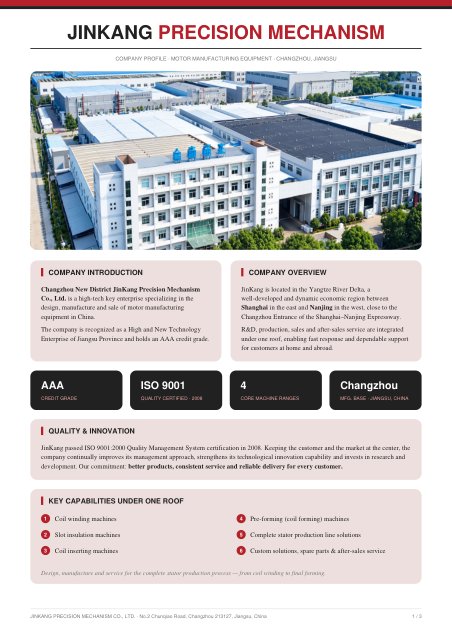
JinKang Precision Mechanism is a high-tech enterprise in Changzhou, China, specialising in the design and manufacture of motor production equipment. During my observership, I observed the stator manufacturing process, which begins with automated machines that carry out the initial production operations.

Stator production line

  1. 1Slot insulation
  2. 2Coil & wedge insertion
  3. 3Coil pre-forming

Machines I observed

  • Slot insulation machine: uses a Programmable Logic Controller (PLC) to synchronise the main shaft and the stator indexing shaft.
  • Coil-inserting machine: inserts the winding coils and wedge paper into the stator slots.
  • Pre-forming machine: shapes the coils for the subsequent manufacturing stages.
Key takeaway

Specialised machinery, PLC-based control systems and automated production lines improve the precision and efficiency of motor manufacturing while reducing manual intervention.
AutomationPLC ControlStator ManufacturingMotor Production Equipment
Prabha Engineering: first page 3 pages

Prabha Engineering

Observership · Mumbai, Pune & Chennai

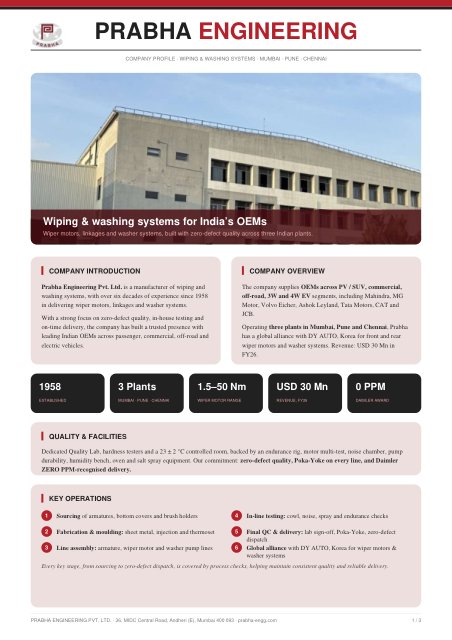
Prabha Engineering manufactures wiper motors, washer units and sheet-metal fabrications, with plants in Mumbai, Pune and Chennai. Here, I learned the stages of a standard manufacturing line for automotive products.

Automotive manufacturing line

  1. 1Sourcing
  2. 2Fabrication & moulding
  3. 3Assembly
  4. 4In-line testing
  5. 5Lab testing
  6. 6Final QC & delivery

What happens at each stage

  • Sourcing and contract manufacturing of components such as armatures, bottom covers and brush holders.
  • Fabrication and moulding, where sheet metal is processed using robotic welding, powder coating and press brakes.
  • Semi-automatic line assembly and automation, followed by in-line testing for cowl, noise, spray and endurance.
  • Laboratory quality testing under controlled temperatures, covering endurance, motor performance, noise (in a noise chamber), humidity and more.
  • Final quality control, followed by delivery.
Key takeaway

How precision engineering and manufacturing techniques ensure the functionality, reliability and performance of automotive units.

Automotive ManufacturingRobotic WeldingQuality TestingAssembly Lines
DN Castech: first page 2 pages

DN Castech

Observership · Grey & ductile iron foundry

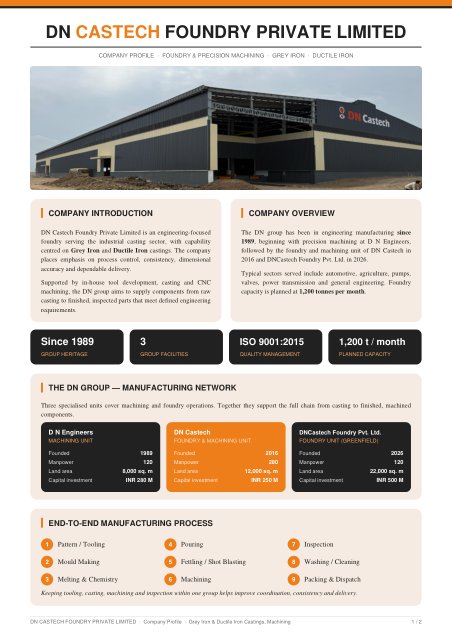
DN Castech is an engineering-oriented foundry that manufactures industrial castings in grey iron and ductile iron, with about 1,000 tonnes of utilised capacity per month. I learned the end-to-end process of manufacturing castings.

~1,000 tof castings per month
2materials: grey & ductile iron

Casting process

  1. 1Tool design & development
  2. 2Casting
  3. 3Machining & finishing
  4. 4CMM inspection
  5. 5Quality control
  6. 6Dispatch
Key takeaway

How a manufacturer plans for growth. DN Castech is now focusing on high-pressure moulding lines, a shell-core foundry, an expanded machining facility and robotic-cell machining automation.

FoundryCastingCMM InspectionExpansion Planning
Hindustan Electric Motors Industries: first page 3 pages

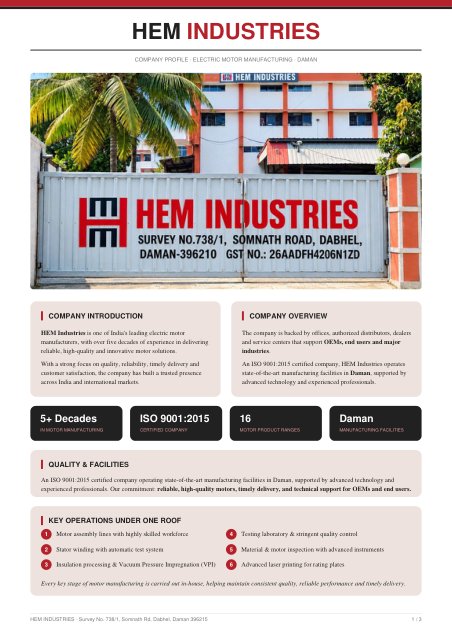
Hindustan Electric Motors Industries

Observership · Daman

Hindustan Electric Motors Industries, located in Daman, manufactures electric motors for industrial applications. During my observership, I studied the motor manufacturing process and observed the material inspection, performance testing and quality-control procedures that ensure every motor meets its required specifications.

Motor manufacturing process

  1. 1Stator winding
  2. 2Insulation
  3. 3Vacuum Pressure Impregnation (VPI)
  4. 4Motor assembly
  5. 5Testing & quality control
Most interesting process

Laser printing on motor nameplates. Lasers create precise, durable markings of the motor type, rated power, voltage, current, speed and frequency. It was different from the marking methods I had seen before and introduced me to the role of laser technology in motor manufacturing.

Motor ManufacturingVPILaser MarkingQuality Control
Paras Pump: first page 2 pages

Paras Pump

Observership · Bagwada, Gujarat

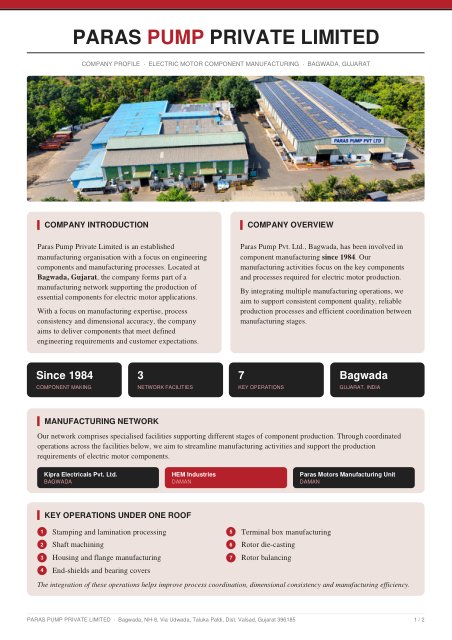
At Paras Pump, I explored the manufacturing of pumps and the components required for their operation. I followed each production stage and examined how pump housings, flanges and terminal boxes are made and integrated into the final product.

Pump production

  1. 1Metal stamping
  2. 2Rotor die-casting
  3. 3Rotor & shaft manufacturing
  4. 4Rotor balancing
  5. 5Housings, flanges & terminal boxes
Most valuable learning

Inspecting a terminal box in detail. Examining its internal circuits and electrical connections first-hand helped me understand how electrical components are arranged and connected within a pump system, linking my theoretical knowledge to practical engineering.

Pump ManufacturingDie-CastingRotor BalancingElectrical Systems
100%